Scientists from around the world will gather to discuss the liver sinusoid, a specialized type of blood capillary found in the liver, and its role in ageing, regeneration, and disease
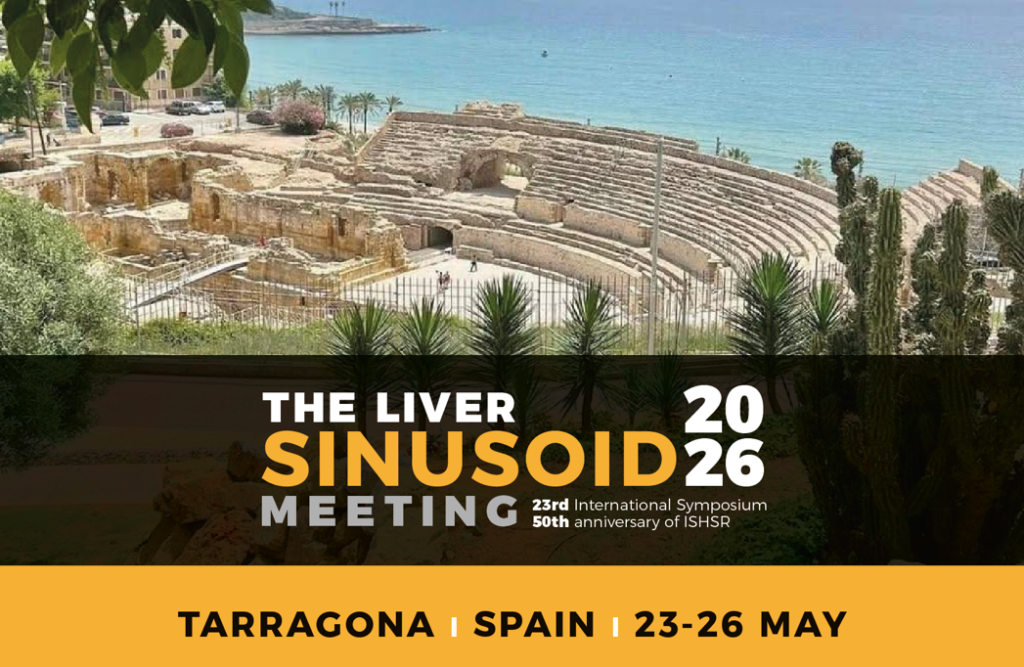
Promotional poster for the international congress that will be held next year in Tarragona.
From May 23 to 26, 2026, Tarragona will welcome researchers and professionals specializing in liver sinusoidal biology. Under the theme of understanding the crucial role of the liver sinusoid in hepatic function, disease progression, ageing, and tissue regeneration, The Liver Sinusoid Meeting 2026 will mark the 23rd edition of this prestigious event. It will also coincide with the 50th anniversary of its organizing body, the International Society for Hepatic Sinusoidal Research (ISHSR).
IRB CatSud researchers Jordi Gracia-Sancho and Sonia Fernandez Veledo are members of the organizing committee, the first being the president of the ISHSR.
This scientific meeting aims to explore the complexity of liver microcirculation, immune regulation, and cellular interactions within the sinusoidal space. The program will highlight the latest advances in sinusoidal endothelial cell biology, liver immunology, fibrosis, and innovative therapeutic approaches.
Attendees will have the opportunity to learn from a distinguished group of international experts who will lead discussions on current challenges and future directions in liver sinusoid research. In addition to scientific sessions, the congress will feature a cultural program, including guided tours of Tarragona’s Roman heritage sites.
Registration and Abstract Submission
The Liver Sinusoid Meeting 2026 opens its registration period from October 1 to December 31, both days this year 2025. The congress is also open to a call for research and there is time to present it until December 31, 2025.
Among those present in the organizational committee, is the head of the area of Metabolic Diseases and Nutrition of Institut d’Investigació Sanitària Pere Virgili, Sonia Fernández-Veledo, also responsible for the research group in ‘Diabetes and Associated Metabolic Diseases’ (DIAMET).
The scientific meeting receives the institutional support of: Departament de Recerca i Universitats de la Generalitat de Catalunya, Patronat Municipal de Turisme de Tarragona, Ajuntament de Tarragona, Centro de Investigación Biomédica en Red en el Área de Enfermedades Hepáticas y Digestivas and Instituto de Salud Carlos III.
We are celebrating our anniversary!
20 years of research in the region
In 2025, the Institut d’Investigació Sanitària Pere Virgili (IISPV) celebrates 20 years of promoting research in health and biomedicine across the region. With more than 600 professionals and 38 research groups, the institute has become a key reference in transferring scientific knowledge to clinical practice. Years after its foundation, it continues working to improve the health and well-being of the population.
We use cookies on our website to give you the most relevant experience by remembering your preferences and repeat visits. By clicking “Accept All”, you consent to the use of ALL the cookies. However, you may visit "Cookie Settings" to provide a controlled consent.
This website uses cookies to improve your experience while you navigate through the website. Out of these, the cookies that are categorized as necessary are stored on your browser as they are essential for the working of basic functionalities of the website. We also use third-party cookies that help us analyze and understand how you use this website. These cookies will be stored in your browser only with your consent. You also have the option to opt-out of these cookies. But opting out of some of these cookies may affect your browsing experience.
Necessary cookies are absolutely essential for the website to function properly. These cookies ensure basic functionalities and security features of the website, anonymously.
Functional cookies help to perform certain functionalities like sharing the content of the website on social media platforms, collect feedbacks, and other third-party features.
Performance cookies are used to understand and analyze the key performance indexes of the website which helps in delivering a better user experience for the visitors.
Analytical cookies are used to understand how visitors interact with the website. These cookies help provide information on metrics the number of visitors, bounce rate, traffic source, etc.
Advertisement cookies are used to provide visitors with relevant ads and marketing campaigns. These cookies track visitors across websites and collect information to provide customized ads.